Mas a Jehová vuestro Dios serviréis, y él bendecirá tu pan y tus aguas; y yo quitaré toda enfermedad de en medio de ti. (Éxodo 23.25)
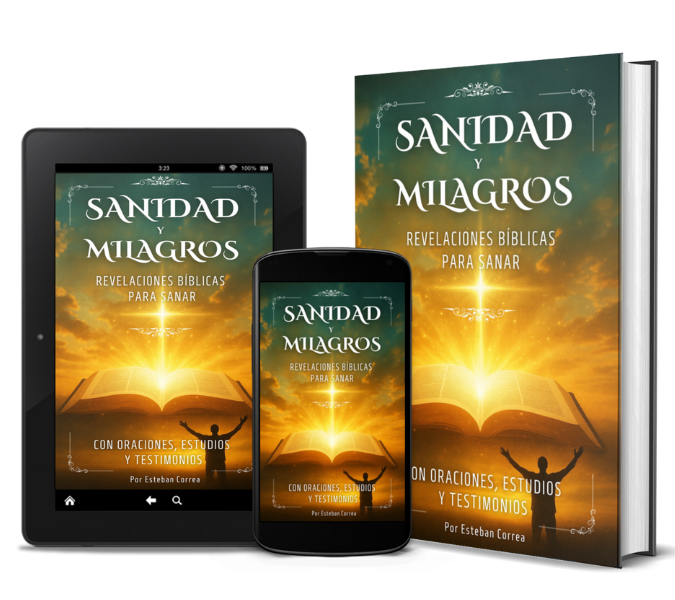
Hay una gran diferencia entre sanidad divina y salud divina. La primera hace referencia a la intervención sobrenatural de Dios con el fin de sanar el cuerpo enfermo, la segunda es la bendición de caminar diariamente saludables y libres de toda enfermedad a causa del poder protector de Dios. Algunas personas reciben sanidad divina pero al tiempo nuevamente se enferman o decaen. Tú puedes pedirle a Dios que te mantenga siempre sano y fuerte, que por tus venas corra el influjo divino otorgándote salud y rejuvenecimiento permanente.
Tener salud Divina es mantenerse sano mediante el poder sobrenatural de Dios, todos los días. El Señor en su palabra promete bendecir el pan que comemos y el agua que bebemos y además agrega que quitara toda enfermedad de nuestro medio. Tenemos motivos más que suficientes y base en las escrituras para vivir y disfrutar la salud divina. Tal vez has recibido hace un tiempo un milagro, el toque sanador de Dios, pero ahora estas nuevamente enfermo, o tal vez una nueva dolencia te afecta hoy. Dios no ha cambiado y te ofrece sanidad y la salud que necesitas para caminar cada día en bendición total. Recíbelas ahora.
Amado Señor: gracias te doy por todas la veces que he recibido el toque sanador de tu mano sobre mi. Creo sin lugar a dudas que así como me sanas, tienes el poder de mantenerme sano. Imparte ahora por medio de tu Espíritu Santo, salud divina y rejuvenecimiento. Estando sano y fuerte puedo ser útil a los que me rodean y servirte, glorificando tu santo nombre, lo pido en el nombre de Jesús, amen
How Casinosforusdt Explains USDT’s Growing Role in Canadian Online Gambling
The Canadian online gambling market has undergone a significant structural transformation over the past several years, driven in part by the broader legalization of single-event sports betting in 2021 and the subsequent provincial licensing frameworks that followed. Ontario’s launch of its regulated iGaming market in April 2022 marked a turning point, creating a competitive environment where operators needed to differentiate themselves not only through game selection and bonuses but also through payment infrastructure. It is within this shifting landscape that Tether (USDT), the world’s largest stablecoin by market capitalization, has carved out a meaningful and growing role. Unlike Bitcoin or Ethereum, whose price volatility made them awkward instruments for gambling transactions, USDT offered something more practical: the speed and borderless nature of cryptocurrency combined with the price stability of the US dollar. Understanding how this dynamic developed, and why Canadian players in particular have gravitated toward USDT as a deposit and withdrawal method, requires looking at both the regulatory environment and the technical realities of stablecoin infrastructure.
The Regulatory Context Shaping USDT Adoption in Canada
Canada’s approach to online gambling regulation is decentralized by design. The Criminal Code of Canada historically permitted provinces to operate lottery and gaming schemes, but for decades this was interpreted narrowly. The 2021 amendment to Section 207 of the Criminal Code, which came into force in August of that year, allowed provinces to offer single-event sports wagering — a change that had been blocked for nearly three decades. Ontario moved fastest, establishing iGaming Ontario as a subsidiary of the Alcohol and Gaming Commission of Ontario (AGCO) and opening its regulated market to private operators in April 2022. By early 2024, that market had generated over CAD 2.1 billion in gross gaming revenue and attracted more than 40 licensed operators.
However, the regulatory framework in Ontario — and across other provinces that have been slower to act — does not explicitly address cryptocurrency payment methods in a comprehensive way. The AGCO’s Registrar’s Standards for Internet Gaming, updated in 2022, require operators to implement anti-money laundering (AML) controls and know-your-customer (KYC) procedures, but they do not prohibit the use of stablecoins. This regulatory ambiguity has created a dual-track market: licensed Ontario operators who accept USDT must do so within a compliance framework that includes transaction monitoring, while offshore-licensed platforms serving Canadian players operate under different jurisdictional rules entirely. FINTRAC, Canada’s financial intelligence unit, classifies virtual currency exchanges and certain dealers as reporting entities under the Proceeds of Crime (Money Laundering) and Terrorist Financing Act, but the application of these rules to gambling platforms accepting USDT directly remains an evolving area of enforcement.
This ambiguity has, paradoxically, accelerated USDT adoption. Players who want faster withdrawals, lower transaction fees, and a degree of financial privacy have found stablecoins to be a practical workaround to the friction inherent in traditional banking channels. Canadian banks, including the major chartered banks like RBC, TD, and Scotiabank, have been notably cautious about processing gambling-related transactions, sometimes declining or delaying payments to and from online casinos. USDT transactions, which settle on the blockchain within minutes regardless of banking hours or institutional policies, sidestep these friction points entirely.
How USDT Functions Differently from Other Crypto in Gambling Contexts
To understand why USDT specifically has gained traction rather than other cryptocurrencies, it is necessary to examine the mechanics of stablecoin design and how they interact with the practical needs of gamblers. Bitcoin, despite being the most widely recognized cryptocurrency, introduces a layer of financial risk that most gamblers are not seeking. If a player deposits 0.01 BTC when Bitcoin is trading at CAD 70,000, and then Bitcoin drops 15% over the next week before they withdraw, they have effectively lost money on the currency itself in addition to any losses at the tables. This volatility risk runs counter to the fundamental purpose of a gambling bankroll, which is to be a stable unit of account against which wins and losses are measured.
USDT eliminates this problem. Pegged 1:1 to the US dollar and maintained through a reserve system managed by Tether Limited, USDT allows players to think in dollar terms while still benefiting from blockchain-based transaction infrastructure. The TRC-20 version of USDT, which runs on the TRON network, has become particularly popular in gambling contexts because its transaction fees are typically less than one US dollar, compared to the Ethereum network’s ERC-20 USDT, which can carry gas fees of several dollars during periods of network congestion. For a player making multiple deposits and withdrawals in a session, fee efficiency matters. Platforms that have studied this user behavior — including resources like https://www.casinosforusdt.com, where the mechanics of USDT gambling are documented in detail — have noted that TRC-20 adoption among Canadian users has grown substantially since 2022, largely because of this fee advantage.
Withdrawal speed is the other critical differentiator. Traditional payment methods available to Canadian online gamblers — Interac e-Transfer, credit cards, and bank wires — each carry their own delays. Interac e-Transfer withdrawals from online casinos can take one to five business days. Credit card refunds are often subject to processing windows of three to seven days, and some card issuers block gambling transactions outright under their own internal policies. Wire transfers are slower still. A USDT withdrawal, by contrast, typically confirms on the blockchain within two to five minutes regardless of the time of day or day of the week. For players who want immediate access to their funds — particularly after a winning session — this is a qualitatively different experience.
The Infrastructure Behind USDT Gambling Platforms Serving Canadian Players
The technical and business infrastructure supporting USDT gambling has matured considerably since the early days of Bitcoin casinos in the 2013-2015 period. Early crypto gambling platforms were often rudimentary, operating with provably fair algorithms but limited game libraries and minimal customer support. The current generation of USDT-accepting platforms serving Canadian players is substantially more sophisticated, typically offering full casino suites including live dealer games from providers like Evolution Gaming and Pragmatic Play Live, sports betting markets with competitive odds, and mobile-optimized interfaces.
From a payment processing standpoint, these platforms generally integrate with one or more of several cryptocurrency payment processors that handle the conversion and settlement mechanics. Some platforms maintain USDT balances directly in their treasury, accepting USDT deposits and paying out USDT withdrawals without converting to fiat at any stage. Others use processors that allow players to deposit USDT while the platform settles in fiat internally, presenting USDT as a front-end option while managing currency risk on the back end. The distinction matters for players because it affects whether their account balance is denominated in USDT or in a fiat currency equivalent, and consequently whether they are exposed to any conversion fees at the point of withdrawal.
Casinosforusdt, as a resource that tracks and analyzes the USDT gambling ecosystem, has documented the differences between these operational models in considerable detail. Platforms that maintain native USDT balances tend to attract more sophisticated crypto-native users who want full stablecoin exposure, while hybrid models appeal to players who are comfortable using USDT as a payment rail but prefer to think about their balance in CAD or USD terms. The distinction also has tax implications for Canadian players, since the Canada Revenue Agency treats cryptocurrency transactions as barter transactions for income tax purposes, meaning that converting USDT to fiat at any stage may technically constitute a taxable disposition — though in practice, enforcement in the gambling context remains limited and the CRA has not issued specific guidance on stablecoin gambling transactions.
The licensing geography of these platforms is also worth examining. The majority of USDT-accepting casinos serving Canadian players are licensed in jurisdictions such as Curaçao, Malta (through the Malta Gaming Authority), Gibraltar, and the Isle of Man. Curaçao has historically been the most permissive licensing jurisdiction and the most commonly used by crypto-focused gambling operators, though it has been undergoing a regulatory overhaul since 2023 under the National Ordinance on Offshore Games of Hazard, which is expected to tighten requirements for operators holding Curaçao licenses. Malta Gaming Authority licenses, by contrast, carry stricter AML and player protection requirements, and MGA-licensed operators accepting USDT must demonstrate that their crypto payment processing complies with the EU’s evolving framework on crypto-asset regulation, including the Markets in Crypto-Assets (MiCA) regulation that came into full effect in 2024.
Player Behavior, Market Trends, and the Future of USDT in Canadian Gambling
Survey data and platform analytics from the 2022-2024 period paint a consistent picture of who is using USDT in Canadian online gambling contexts. The demographic skews younger — predominantly players between 25 and 44 — and is more likely to include individuals who already hold cryptocurrency for investment or transactional purposes. This is not a population that adopted USDT specifically for gambling; rather, it is a population that was already comfortable with digital asset wallets and recognized USDT as a natural fit for gambling transactions given its stability and speed. The adoption curve has followed the broader pattern of cryptocurrency ownership in Canada, where Statistics Canada data from 2023 indicated that approximately 13% of Canadians owned some form of cryptocurrency, up from roughly 5% in 2018.
The growth in USDT gambling activity has not gone unnoticed by the regulated market. Several operators licensed under iGaming Ontario have begun exploring or quietly implementing USDT payment options, navigating the compliance requirements carefully. The AGCO has not issued a blanket prohibition on cryptocurrency payments, and some operators have structured their USDT integration through licensed crypto payment processors that handle the AML reporting obligations, allowing the casino to offer USDT as a payment method while remaining compliant with the Registrar’s Standards. This is a meaningful development because it suggests that USDT is moving from being exclusively an offshore-market phenomenon to having a foothold in the regulated Canadian market.
The trajectory of USDT adoption is also being shaped by broader developments in the global stablecoin market. Tether’s USDT remains dominant, but competitors including Circle’s USDC and PayPal’s PYUSD have entered the stablecoin space with different reserve transparency models and regulatory relationships. USDC, which is issued by a US-regulated entity and undergoes regular attestations by major accounting firms, has attracted some gambling operators who prefer its compliance profile. However, USDT’s network effects — its deeper liquidity, wider exchange support, and larger user base — have kept it as the primary stablecoin in gambling contexts globally, including in Canada. Casinosforusdt’s ongoing analysis of platform adoption rates has consistently shown USDT accounting for the majority of stablecoin gambling volume, with USDC a distant second.
Looking ahead, the intersection of Canadian gambling regulation and stablecoin technology will likely be shaped by several converging forces. Provincial regulators outside Ontario are watching the Ontario experiment closely, and British Columbia, Alberta, and Quebec have all signaled varying degrees of interest in expanding their regulated online gambling frameworks. If additional provinces open regulated markets, the question of whether and how to accommodate USDT payments will need to be addressed explicitly rather than left in the current state of regulatory ambiguity. At the federal level, any future legislation addressing digital assets — whether through an updated version of the Proceeds of Crime framework or through new digital asset legislation — will have implications for how gambling operators can accept and process USDT.
The story of USDT’s growing role in Canadian online gambling is ultimately a story about infrastructure meeting demand. Canadian players encountered friction in the traditional banking system when trying to fund gambling accounts, and USDT offered a technically superior alternative that was already familiar to a growing segment of the population. The regulatory environment, rather than actively facilitating this shift, has simply been slow to respond to it — creating space for USDT adoption to accelerate organically. Whether that space narrows as regulators catch up, or whether USDT becomes formally integrated into the regulated Canadian gambling market, will depend on policy decisions that are still taking shape. What is already clear is that stablecoin payments have moved from a niche curiosity to a meaningful component of how a significant minority of Canadian online gamblers manage their funds, and that this shift has enough momentum to make it a permanent feature of the landscape rather than a passing trend.