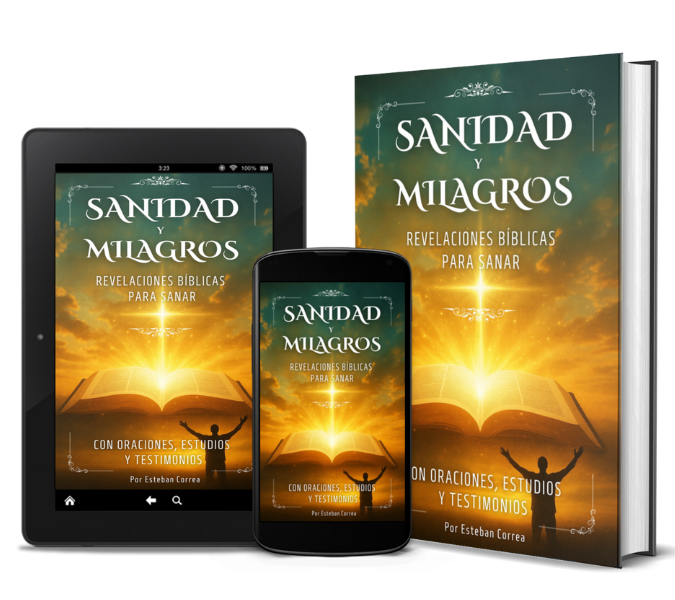
Por Esteban Correa
El perdón es la base de toda sanidad en la mente, conciencia y corazón. El perdón es la clave de la liberación espiritual. El perdón es una barrera que debemos cruzar para ser totalmente libres en nuestro interior. Sin perdón hay dolor, hay rencor, hay resentimiento y amargura. Comienza hoy tu sanidad completa. Veamos a continuación las 4 clases de perdón que existen:
La primer clase de perdón es: “Perdonarse a uno mismo”
Hay situaciones que producen una desilusión de nosotros mismos. Hay actitudes y hechos cometidos por nosotros que nos humillan, nos denigran y avergüenzan. Esta clase de fallas requieren de un auto-perdón. ¡Perdónate! Nadie es perfecto, la misma esencia defectuosa propensa a fallar existe en todos los seres humanos. Perdonarte a ti mismo es aceptar con humildad tu condición real de ser humano. Reconoce que no eres perfecto y comienza a mejorar.
La segunda forma de perdonar es: “Perdonar a otros”
Las heridas duelen y a veces mucho. Pero alguien dijo: “La mejor venganza es el perdón” porque la Falta de Perdón te Auto-Esclaviza. Te lastimas a ti mismo cuando no perdonas, mientras el ofensor no se percata de tus sentimientos. Tu Falta de perdón hacia otros te mantiene preso y atado a esa persona. ¡Se Libre perdonando! Tú eliges entre permanecer preso o hallar la libertad. Confiesa el perdón con tus labios, ¡¡Hazlo Y serás libre por siempre!!
El tercer perdón es: Perdonar a Dios, renunciando a pensar que Él nos falló
How NoCasinosDeposit Explains No Deposit Bonuses to New Zealand Players
For players in New Zealand exploring online gambling for the first time, the sheer volume of promotional offers can be genuinely confusing. Among the most misunderstood of these is the no deposit bonus — a type of promotion that allows players to access real-money games without committing any of their own funds upfront. While the concept sounds straightforward, the mechanics behind these offers involve wagering requirements, game restrictions, maximum cashout limits, and eligibility rules that vary considerably from one operator to another. Resources that break down these conditions in plain language have become increasingly valuable as the New Zealand online casino market has grown in both size and complexity over the past decade. Understanding how these bonuses actually work — not just what they advertise — is essential for anyone who wants to use them effectively rather than be disappointed by fine print they did not read.
What No Deposit Bonuses Actually Are and How They Function in Practice
A no deposit bonus is, at its core, a promotional credit issued by an online casino that does not require the player to make a financial deposit before receiving it. These bonuses typically come in one of two forms: a fixed amount of bonus cash credited to the player’s account upon registration, or a set number of free spins on a specified slot title. In both cases, the value is real in the sense that winnings generated from it can, under certain conditions, be withdrawn as actual money. The critical qualifier here is «under certain conditions,» because the pathway from promotional credit to withdrawable cash is rarely direct.
Wagering requirements are the primary mechanism by which casinos manage the cost of offering no deposit bonuses. A wagering requirement of 30x on a $10 no deposit bonus means the player must place $300 in total bets before any winnings derived from that bonus become eligible for withdrawal. This is not a hidden trick — it is a disclosed condition — but the way it is disclosed varies enormously. Some casinos present it prominently during registration; others bury it in a terms and conditions document that runs to several thousand words. The industry standard for wagering requirements on no deposit bonuses has historically ranged from 20x to 60x, with some outliers going higher. Offers with requirements above 50x are generally considered difficult to complete profitably, particularly when the eligible games have a return-to-player percentage in the 94–96% range, which is typical for most online slots.
Game weighting is another factor that substantially affects the practical value of a no deposit bonus. Most casinos do not allow all games to contribute equally toward wagering requirements. Slots typically contribute 100%, meaning every dollar wagered on a slot counts fully toward the requirement. Table games such as blackjack, roulette, or baccarat often contribute only 10% or even 0%, which means a player who prefers those games and uses a no deposit bonus will find it almost impossible to clear the wagering requirement through normal play. This distinction is rarely highlighted in promotional materials but is consistently present in the terms and conditions. For New Zealand players who favor table games — and there is a meaningful segment of the market that does — this weighting structure makes many no deposit bonus offers functionally inaccessible.
Maximum cashout limits are the third major constraint. Even if a player successfully clears all wagering requirements, many no deposit bonuses cap the amount that can be withdrawn. A typical cap might be $50 or $100, regardless of how large the winnings were during the bonus play period. This means that a player who runs a $10 no deposit bonus up to $500 through fortunate slot play may only be permitted to withdraw $50 of that amount. The cap exists to limit the casino’s financial exposure on promotional offers, and it is a legitimate business practice, but it is one that frequently surprises players who were not aware of it before claiming the bonus.
The New Zealand Regulatory Context and Why It Matters for Bonus Transparency
New Zealand’s online gambling landscape operates under a regulatory framework that is, by international standards, relatively permissive toward offshore operators. The Gambling Act 2003 governs gambling within New Zealand’s borders, but it was written before the widespread adoption of internet gambling and does not explicitly regulate offshore online casinos in the same way that jurisdictions like the United Kingdom or Malta regulate their domestic markets. As a result, New Zealand players can legally access online casinos licensed in jurisdictions such as Malta, Gibraltar, Curaçao, and the Isle of Man, and those operators are not subject to the same consumer protection obligations that would apply in their home markets.
This regulatory gap has practical consequences for how no deposit bonuses are presented to New Zealand players. In the United Kingdom, for instance, the UK Gambling Commission introduced rules in 2019 and strengthened them in 2021 that required operators to clearly communicate bonus terms, prohibited certain types of wagering requirements on free spins, and mandated that bonus conditions be presented in plain English at the point of offer. New Zealand has no equivalent set of rules imposed on offshore operators. This means that a casino licensed in Curaçao — which is one of the more common licensing jurisdictions for casinos accepting New Zealand players — faces minimal regulatory pressure to present its bonus terms transparently.
The consequence of this environment is that New Zealand players are more dependent on independent information sources than their counterparts in more tightly regulated markets. Sites that aggregate and explain casino bonus terms serve a genuinely functional role in this context, not merely a commercial one. A resource like www.no-casinos-deposit.com, which focuses specifically on explaining no deposit bonus structures to players in markets like New Zealand, provides the kind of comparative analysis that players would otherwise have to conduct themselves by reading through multiple sets of terms and conditions. The value of such resources is directly proportional to the opacity of the operators they cover — and in the New Zealand market, that opacity is often considerable.
It is also worth noting that the New Zealand Department of Internal Affairs, which administers the Gambling Act, has periodically discussed updating the regulatory framework to address online gambling more directly. Consultations were held in the early 2020s around potential reforms, but as of the mid-2020s, no comprehensive legislative update has been enacted. This means the current situation — where offshore operators face limited local oversight — is likely to persist for the foreseeable future, making independent player education resources more important, not less.
How NoCasinosDeposit Structures Its Explanations for New Zealand Audiences
Explaining no deposit bonuses to a general audience requires balancing technical accuracy with accessibility. The challenge is that the terms governing these bonuses are genuinely complex — they involve probability, expected value calculations, contractual fine print, and jurisdiction-specific rules — but the audience seeking information about them is not uniformly financially or mathematically sophisticated. A player who has never gambled online before and is attracted by the idea of a free bonus does not necessarily arrive with the background to evaluate a 40x wagering requirement on a $15 bonus with a $75 maximum cashout and a 7-day expiry window.
NoCasinosDeposit approaches this challenge by breaking down bonus offers into their component parts and explaining each one in isolation before showing how they interact. Rather than simply listing the terms of a given offer, the site contextualizes those terms against what is typical in the market. A player reading about a 35x wagering requirement, for example, benefits from knowing that this falls within the average range for no deposit bonuses, that it is achievable on slots with a high RTP if the player has sufficient time and the bonus does not expire quickly, and that it would be effectively impossible to clear on table games given standard contribution percentages. This kind of contextual framing is what distinguishes genuinely educational content from promotional copy that restates the offer’s terms without interpretation.
The site also addresses the distinction between different types of no deposit bonuses in ways that matter practically. Free spins offers, for instance, have a different risk profile than bonus cash offers. With free spins, the total potential value is fixed — if a player receives 20 free spins on a slot with a $0.10 stake per spin, the maximum bonus value is $2.00, and the winnings generated from those spins are then subject to wagering requirements. The upside is capped, but so is the complexity. Bonus cash offers, by contrast, can be used across multiple games and allow for more strategic play, but they also involve more variables and more opportunities for players to inadvertently violate bonus terms — for instance, by playing a game that is excluded from the bonus or by making a real-money deposit before clearing the wagering requirement, which at some casinos triggers the forfeiture of the bonus.
For New Zealand players specifically, the site addresses questions around currency and payment methods that are relevant to the local market. New Zealand dollar accounts are not universally supported at offshore casinos, which means players may face currency conversion costs that affect the real value of a bonus. A $10 NZD no deposit bonus and a $10 USD no deposit bonus are not equivalent, and the difference matters when evaluating which offers represent genuine value. Similarly, the payment methods available to New Zealand players — which have historically included POLi, credit cards, and various e-wallets — affect the speed and cost of withdrawing any winnings from bonus play, a factor that is often overlooked in bonus comparisons.
Evaluating No Deposit Bonus Offers: A Framework for New Zealand Players
Given the complexity of no deposit bonus terms and the limited regulatory protection available to New Zealand players, a systematic approach to evaluating these offers is more useful than any individual recommendation. The evaluation framework should consider five distinct dimensions: the wagering requirement, the game eligibility and contribution percentages, the maximum cashout limit, the expiry period, and the casino’s withdrawal processing practices.
The wagering requirement should be assessed not in isolation but in relation to the bonus value and the maximum cashout. A 30x wagering requirement on a $5 bonus means $150 in total bets, which is achievable in a single session on most slots. A 50x requirement on a $20 bonus means $1,000 in total bets, which is substantially more demanding and carries significantly more variance — meaning the player is more likely to exhaust the bonus before clearing the requirement simply due to normal statistical fluctuation. The expected loss during wagering can be estimated by multiplying the total required wager by the house edge of the eligible games. For a slot with a 4% house edge and a $1,000 wagering requirement, the expected loss during bonus play is approximately $40, which already exceeds many maximum cashout limits.
Game eligibility is particularly important for players who have established preferences. If a player primarily enjoys live dealer games or video poker, they should verify before claiming any no deposit bonus whether those games contribute to wagering requirements and at what percentage. Many casinos explicitly exclude live dealer games from bonus play entirely, meaning a player who uses a no deposit bonus and then plays live blackjack may find their bonus voided retroactively. This is not a hypothetical risk — it is a common source of player complaints on gambling forums and review sites, and it reflects a genuine communication failure between operators and players around bonus terms.
The expiry period determines how much time a player has to meet the wagering requirement. Seven days is a common window, though some offers expire in as little as 24 hours. For casual players who do not have extended gaming sessions available, a short expiry window can make an otherwise attractive offer practically worthless. A player who can dedicate two hours per week to online casino play will struggle to clear a $500 wagering requirement in seven days unless they are playing at relatively high stakes, which introduces additional variance and risk.
Withdrawal processing practices are the final and often overlooked dimension. Even after meeting all bonus conditions, players may encounter withdrawal delays, identity verification requirements, or minimum withdrawal thresholds that affect when and whether they can access their winnings. Casinos operating in the New Zealand market without local licensing are not subject to mandatory processing time limits, and some operators have been documented taking several weeks to process withdrawals from bonus winnings. Checking independent player reviews for a casino’s withdrawal track record before claiming a no deposit bonus is a practical step that many first-time players skip.
Understanding no deposit bonuses in the New Zealand context ultimately requires recognizing that these offers exist within a commercial relationship where the operator has significant informational advantages over the player. The terms are set by the casino, disclosed in documents that most players do not read in full, and administered by the operator in ways that the player cannot independently verify. This does not make no deposit bonuses without value — they can provide genuine entertainment and occasionally result in real winnings — but it does mean that an informed approach is substantially more likely to produce a satisfactory outcome than a naive one. Resources that explain these mechanics clearly, without oversimplifying or overpromising, serve a meaningful function in a market where regulatory consumer protection is limited and the information asymmetry between operators and players remains substantial.
Dios es perfecto y absolutamente santo, nunca se equivoca, pero muchas veces hay un resentimiento, una actitud inconsciente de que de alguna manera «por la culpa de Dios» se piense que el nos falló. ¿Acaso Dios se equivoca? No, en absoluto. Pero nosotros percibimos por nuestro orgullo e ignorancia que Dios nos ha fallado en algunas ocasiones. Pensamos que ciertas tragedias e injusticias son una falla de Dios. Pero no es así. Cambia tu actitud si estas enojado con Dios. Porque él quiere lo mejor y jamás quiso nada malo para ti. No guardes rebeldías hacia Dios eso te alejará más de tu felicidad. Renuncia a todo enojo con Dios, de forma doctrinalmente incorrecta y solo como una expresión simbólica, deja tus pensamientos necios, di a Dios: «Yo no tengo enojo contra ti»
El cuarto tipo de perdón es: “El Perdón De Dios”
Fallamos muchas veces a Dios. El es el creador de todo y juez del universo. Y Dios, a pesar de ser juez no se complace en juzgar, sino en perdonar. Dios no tiene amor… ES AMOR. La misión de la venida de Cristo a la tierra fue esta: Perdón. Dios nos quiso amar y envío la solución para nuestros pecados. La solución es Jesús, el Hijo de Dios, quién murió en la cruz para derramar su sangre y perdonarnos. No te culpes más si le fallaste a Dios, porque si tienes un arrepentimiento genuino tienes asegurado el perdón de Dios. El así lo prometió. Recibe en este día el amor y la gracia de Dios, porque Él siempre esta dispuesto a olvidar tus fallas para siempre.